
Care tag
- Blot, don’t scrub; scrubbing spreads a stain and damages fibers.
- Never mix bleach with ammonia; EPA says the combination can create toxic vapors.
- EPA’s Safer Choice label means every ingredient was reviewed for health and environmental safety.
Most carpet stains are won or lost in the first few minutes. The good news is that the safest approach is also the simplest: remove as much as you can, use the mildest cleaner that works, and keep moisture under control. Here is a method built on guidance from Ohio State’s veterinary hospital, University of Tennessee Extension and the U.S. Environmental Protection Agency.
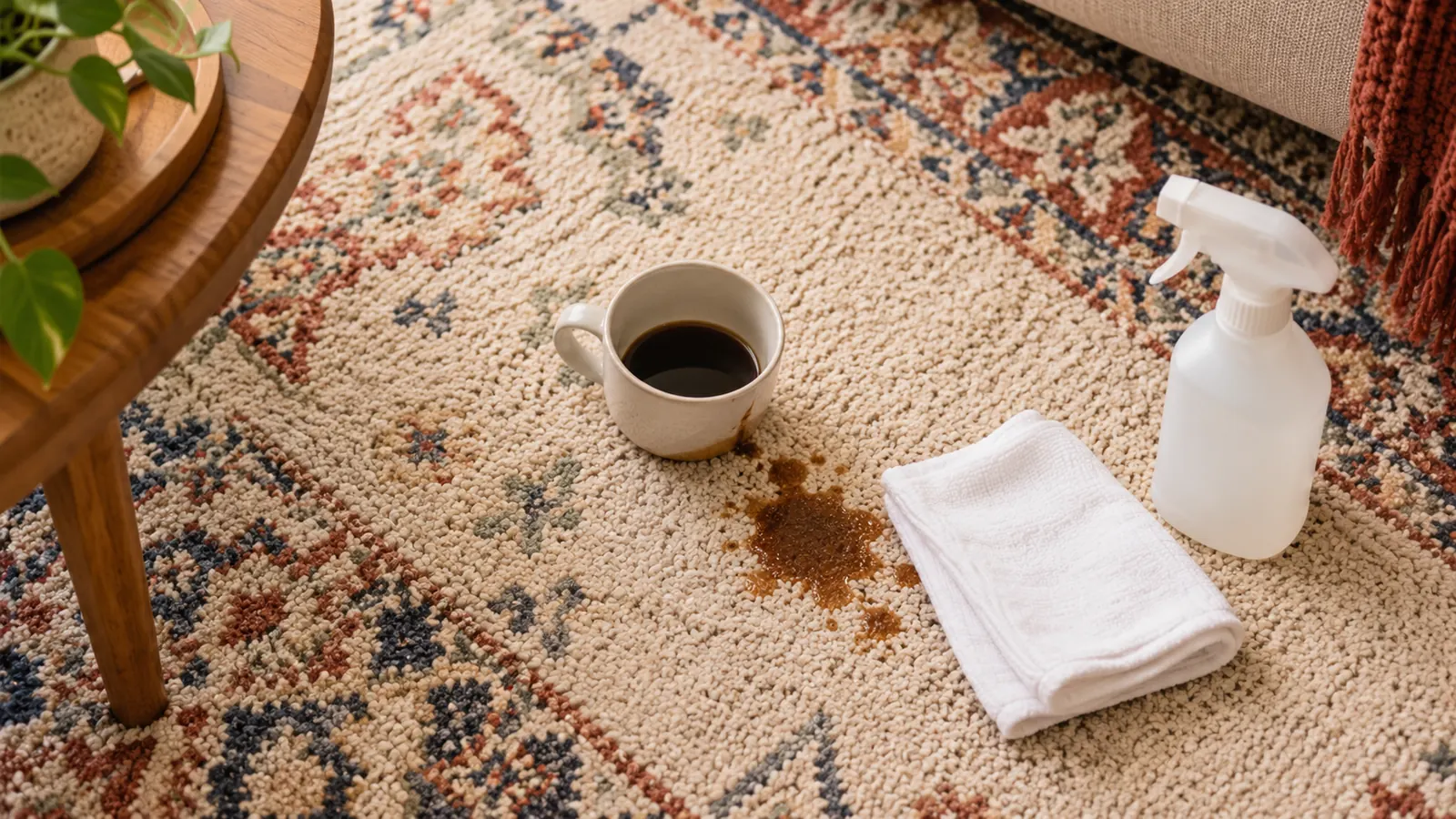
Step 1: Blot, don’t scrub
Ohio State’s veterinary hospital, describing how to clean urine from carpet, starts with the same move that works for most spills: blot up as much as you can as soon as you notice it, cover the spot with towels or paper towels and press down, repeating until little more comes up. Its instructions specify letting the cleaning solution sit without scrubbing. Scrubbing spreads the stain and roughs up the pile.
Step 2: Start mild
For a general spill, the same Ohio State method uses a carpet cleaner or a few drops of dish detergent in water, left to sit on the area for an hour or two, then rinsed by gently blotting with a sponge wet with tap water. That mild detergent approach is a sensible first try for many food and drink spills on synthetic carpet.
Tip: Test any product in a hidden spot first, such as inside a closet or under a sofa. Let it dry fully before you judge whether the color changed.
Step 3: Rinse and dry
Rinse by blotting with clean water, then dry the area thoroughly. Ohio State’s method finishes by placing fresh towels over the spot and weighing them down with books overnight to draw out moisture. EPA’s mold guidance says damp materials dried within 24 to 48 hours will not, in most cases, grow mold.
Choosing a safer product
EPA’s Safer Choice label is a quick way to narrow the shelf. EPA says that before a product can carry the label, it reviews all chemical ingredients regardless of their percentage, each must meet strict criteria for human health and the environment, and the product must perform comparably to conventional products. EPA says the program also looks at product performance, pH and packaging, not just ingredients. Nearly 2,000 products qualify, for homes and for facilities such as schools and offices. UT Extension adds a simple rule for any product: keep all cleaning products away from young children.
Ventilate
Many cleaning products release volatile organic compounds. EPA reports that concentrations of many VOCs are consistently higher indoors, up to ten times higher, than outdoors, and advises increasing ventilation when using products that emit them and following label instructions carefully. Open a window or run a fan while you work. EPA’s long-running TEAM study found levels of about a dozen common organic pollutants to be 2 to 5 times higher inside homes than outside, whether the homes were rural or highly industrial.
Mistakes to avoid
- Never mix bleach with ammonia. University of Tennessee Extension lists this as a basic rule, and EPA warns the combination can create toxic vapors.
- Do not mix cleaning products at all; use one, rinse, then try another if needed.
- Avoid ammonia-based products on pet accidents; Ohio State says the smell can draw a cat back to the spot.
- Do not soak the carpet; too much water reaches the pad and backing.
- Keep chlorine bleach off carpet unless the manufacturer allows it; UT Extension describes bleaches as products used to whiten materials.
Quick reference
| Spill | First move | Then |
|---|---|---|
| Drinks, food | Blot immediately | Mild detergent solution, rinse, dry |
| Pet urine | Blot and press with towels | Detergent, rinse, then an enzymatic cleaner; see the pet guide |
| Water from a leak | Remove water with a wet vacuum | Dry within 24 to 48 hours; see the water damage guide |
| Unknown or valuable rug | Blot only | Ask a specialist before using any cleaner |
When a stain keeps coming back
A mark that reappears as the carpet dries is often coming up from the pad. Ohio State’s advice for persistent urine odor is to replace the padding and clean the floor beneath, and EPA warns that absorbent materials such as carpet may have to be thrown away if they become moldy, because mold can fill the spaces in porous materials and be difficult or impossible to remove completely.
When to stop
Stop if the color starts to transfer to your towel, if the rug is wool, silk or hand-knotted, or if a stain keeps returning after it dries, which can mean it is coming up from the pad. EPA notes that for items that are expensive or of sentimental value, consulting a specialist in carpet and rug cleaning may be the wiser choice. Wool rugs are covered in Caring for Wool and Oriental Rugs: Vacuuming, Moths, Pads and Storage, and pet problems in Pet Stains and Odors on Carpet: A Vet-School Method That Stops Repeat Accidents.